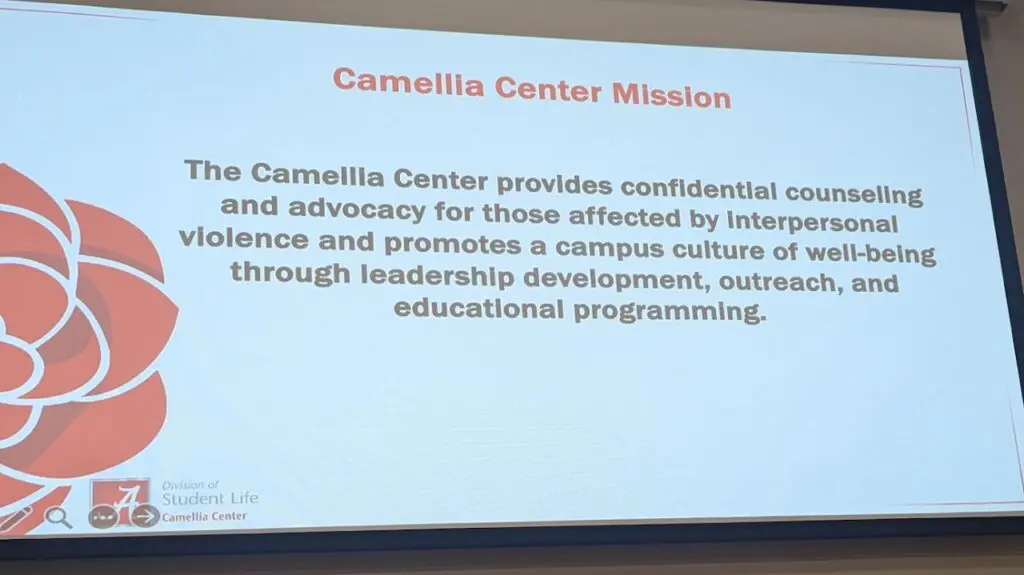
TUSCALOOSA, Ala. – A recent University of Alabama graduate spoke to a journalism class on a particular counseling center, the resources it provides, and how students can get involved.
Formally known as the “Women and Gender Resource Center” before May 2025, the Camellia Center offers a variety of resources to fit the various needs of students. They provide several different forms of counseling from individual to group sessions.
“Being there to support our students is our main goal,” said Rylie Voyles, a recent UA graduate who now works for the Camellia Center. She spoke to a UA journalism class on the role of the Camellia Center.
Voyles made it clear that these cases of violence can occur between not just romantic partners, but also between friends, roommates, colleagues, or other non-sexual relationships.
Through the phone, students can access a 24/7 on-call advocacy line where there is always someone ready to assist student needs. Similarly, students have access to an immediate crisis intervention hotline.
“It’s nice to know I have a place to go in case I ever experience any violence,” said Mary Adams, a junior from Albertville, Alabama who was in attendance for the class. Adams is a transfer student studying news media.
“I feel like I learned a lot more about campus resources,” said Adams, after reflecting on the impact of the in-class speaker.
The Camellia Center addresses various forms of violence, and the rates on these cases can be found in the University of Alabama Annual Security and Fire Report. Between 2021 and 2023, the number of reported rape cases was consistent at 31. The number of reported dating violence cases went down from 21 to 18.
The University of Alabama Police Department can be found on and off campus. Also on campus, is the Office of Title IX, which is available for students facing gender-based discrimination.
There are several off-campus resources such as Turning Point and Tuscaloosa SAFE House. Turning Point is a program created for survivors of domestic and sexual violence. Tuscaloosa SAFE House is another 24/7 on-call advocacy center that has no mandatory reporters as they are not affiliated with any hospitals.
With the many resources available in assisting victims of violence, the Camellia Center also provides ways for students to volunteer and learn more about these resources.
Students can serve as ambassadors, tabling events and educating faculty, staff, and fellow students on the Camellia Center’s mission. There are Federal Work Study and internship opportunities available as well.
Voyles mentioned the Harbor Training and the Thrive Together Mentorship Program.
“We go over what it means to be a mandatory reporter and an effective bystander,” said Voyles, when describing the benefits of Harbor Training.
Iota Iota Iota, also known as Triota, is the Women’s Studies Honor Society with key focuses on research, community, and social issues.