TUSCALOOSA, Ala. – Two journalism professionals spoke to an audience of University of Alabama students on the ethical uses of artificial intelligence in journalism on Friday, Nov. 14 in a former newsroom turned classroom.
The rise of AI has leaked its way into journalistic practices. While the future of this new technology is still unknown, two journalism professionals emphasized the importance of emphasizing ethical codes.
“We’re still in the wild west of it…everyone is kind of making up the rules as they go,” said Stephen Dethrage, editor-in-chief of the Tuscaloosa Thread.
The sudden introduction of AI in professional fields has opened up discussions about the ethical practices of this technology. In journalism, this has sparked debate on how AI could and should be used in producing stories.
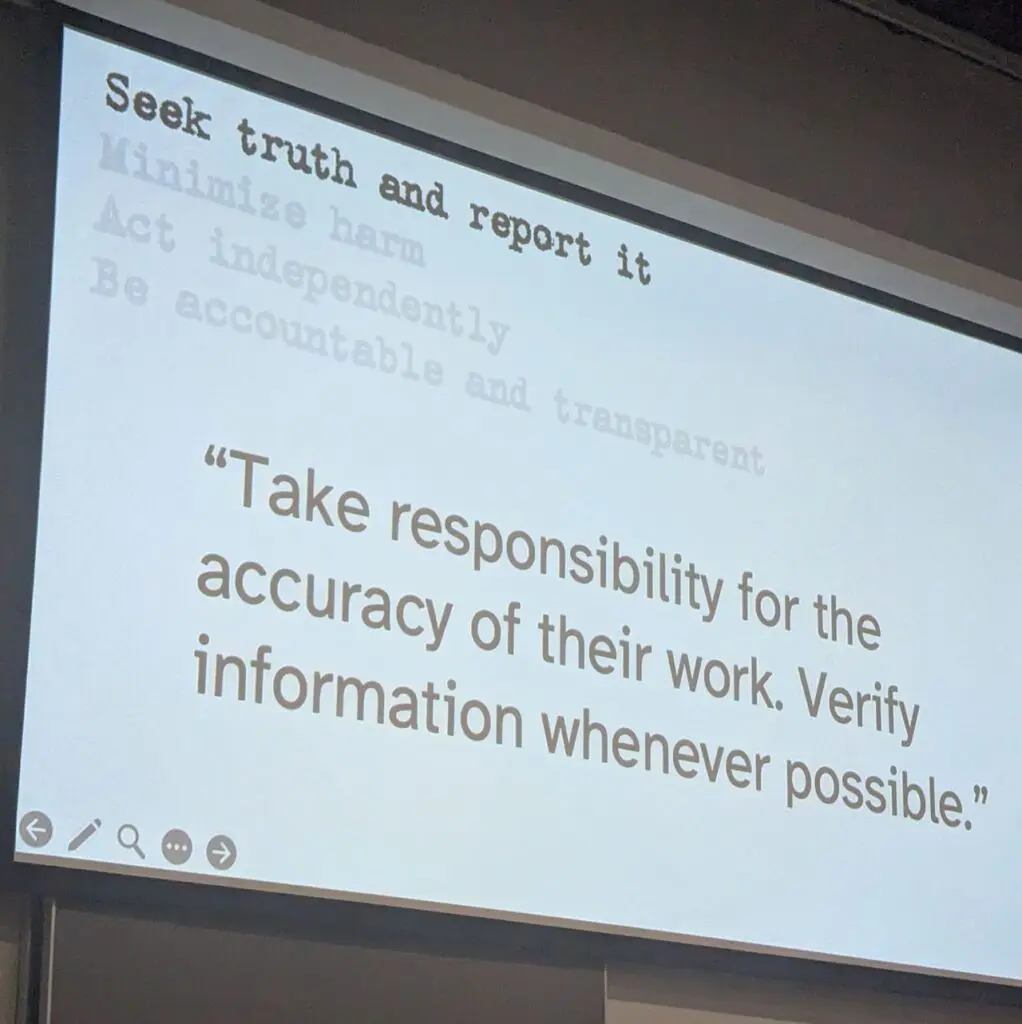
“Ethics is more important than ever,” said Dethrage. Because the Society of Professional Journalists Code of Ethics has no entry on the use of AI, it is currently up to individual reporters and news outlets to use AI to their discretion.
Some journalism students have been utilizing the ease and practicality of AI over ethical practices to produce news stories for assignments. One professor says that students should be able to do the work of writing news stories on their own before using AI as an aid.
“No matter what technology you use, you are responsible for what gets published,” said Chris Roberts, the director of the UA Office of Research in Media Integrity and vice chairman of the ethics committee of the Society of Professional Journalists.
Roberts has been able to successfully catch students in the classroom who have turned in stories written by AI without giving proper credit. He states that his ability to spot AI-produced content is due to his knowledge of writing news stories.
“You can spot a counterfeit if you know what the real thing looks like,” said Roberts, after explaining the consequences of utilizing AI to write stories without having the proper understanding of developing a legitimate story.
Both Roberts and Dethrage also discussed the limitations of AI in journalism.
Dethrage explained how AI cannot be of assistance in writing stories centered around events in which the Internet was not present. For example, an event occurring in a court room cannot be covered by AI as this kind of information would not be present on the Internet.
Roberts mentioned that students and professional journalists cannot use AI to bypass ethical reporting.
“No matter what technology you use, you are responsible for what gets published,” said Roberts.
While the future of AI is uncertain, it is clear that journalists, whether professional or students, should always practice ethical standards to the best of their ability. The two speakers agreed that AI should not be a crutch, but rather a resource used in a finite way.